Saturday, June 16, 2007

SACRE III


As every year I have finalized program SACRE of this season, two squares that I made a route detecting the present birds, to determine throughout the time the variations of the populations.

In square VN4040, with data from 1999, I have located to this season a total of 64 different species.
Altogether, during the 9 years that I take making this grid, I have located a total of 91 species.


Species that have been detected, this year, for the first time, in VN4040.


Hawfinch (Coccothraustes coccothraustes)
Great reed Warbler (Acrocephalus arundinaceus)


In square VN3040, I take to only two years making the census, have located to this season 62 species.
During these two years I have located a total of 71 different species.


So far, it is difficult still to draw conclusions to from a square, although at least, begins to glimpse, as the most abundant birds maintain numbers similar.


Common Cuckoo (Cuculus canorus)
Although the listening places, are well separate, is necessary to have precaution of not entering the same individual two times, Common Cuckoo it is listened to them distance.


Woodpigeon (Columba palumbus)


Wren (Troglodytes troglodytes)
Blackbird (Turdus merula)


Great Tit (Parus major)

Carrion Crow (Corvus corone)


Common Chafinch (Fringilla coelebs)

Friday, June 01, 2007

Red-rumped Swallow


One of the birds that can more represent the climatic change is the Red-rumped Swallow (Hirundo daurica), an African Swallow, who step by step this moving it’s breeding areas more and more to the north, by this is one of the species of recent colonization in the province of Burgos, although certainty of it’s presence in the south of the province, now in patent was had its presence and breeding in the north.
This week I have been able to observe a pair of Red-rumped Swallow who after constructing their characteristic nest have begun to rear, seeing them easily enter and leave it’s nest.

Tuesday, May 15, 2007

Making Reforms

Although I do not like to make photos to nests of birds, in this case I think that is good to see the reforms made in a nest of Great spotted woopecker by our protagonists.
The photos I have made by means digiscoping techniques, reason why the observed distance has been the sufficiently good like so that the birds were not bothered.

As we can see this is a hole of a nest Great Spotted Woopecker (Dendropocos major).

Here we can see since the reform has been made, reducing with mud the inlet diameter of the hole, until obtaining the suitable one.

Here we have the authors of this peculiar adaptation, the Nuthatch (Sitta europaea).


Thursday, May 03, 2007

Yearbook, January-March 2007


Updated the Ornithological Yearbook of the province of Burgos , with the new report of January, February and March with interesting records of wintering and migrate birds .

Mandarin Duck (Aix galericulata )
Garganey (Anas querquedula)
Monk Vulture (Aegypius monachus)
Spanish Imperial Eagle (Aquila adalberti )
Hoopoe (Upupa epops)
Black Woodpecker (Dryocopus martius )
......
Also interesting records in the home page.

Sunday, April 29, 2007

Iberian Chiffchaff


One of the splits more controverted on species in the Iberian peninsula is the one that took on the Phylloscopus collybita, split accepted by the rarities committees and that in Spain, have taken to ornithologists to take extra precautions to separate the new species, the Common Chiffchaff (Phylloscopus collybita) and the Iberian Chiffchaff (Phylloscopus ibericus), denominated firstly like P. brehmii.
Still the discussions on the different identifications continue in diverse ornithological sites, forums etc...
In the field, in a typical observation, these two species are practically indistinguishable, although there are authors who indicate subtle differences in the color of the plumage.
Nevertheless, when we listened to it’s different songs we can determine as of both we are listening, that yes, whenever they emit his normal songs, since mixed songs can be listened, that can mistake.
The song of the Iberian Chiffchaff is a song faster, and normally shorter than the Common Chiffchaff , and that it finalizes with a very characteristic trill.
Look here!
The song of the Common Chiffchaff is slower and longer in the time, giving the sensation of which is sadder.
In several zones of the north of Spain it is easy to listen several of these mixed songs.
The origin of these songs, is difficult to attribute to the species exactly, some ornithologists, attribute these songs to imitations of Common Chiffchaff , others say that they are imitations of Iberian Chiffchaff , and many we decided on the sensation and the intuition to attribute to certain songs to a species or another one.
In order to clarify many of these doubts, the Iberian Ringning Group – Grupo Ibérico de Anillamiento. GIA - , it has prepared the first congress on the Iberian Chiffchaff , that will be celebrated in Riello (León), from 11th to 13th of May and that has great specialists of this species, Lars Svensson, José Luis Copete, Gozalo Elias, Alejandro Onrubia, Alfonso Balmori, …aspects on morphology, songs, distribution etc…. will treat.
Let us hope that the conclusions contribute means to us to differentiate these difficult species.
You have more information HERE (PDF file)

Friday, April 27, 2007

Lagoons


Great number of migratory birds has arrived, in a stroll by the lagoons of Gayangos it is possible to see and to listen many of these birds.
The lagoons of Gayangos conform one of the few wetlands of the province of Burgos.
They are composed by three main lagoons and other than is stationary because it is dried at times of summer.
In these lagoons it is possible to find great number of species of birds, being the most showy aquatic birds, Ducks, Grebes, Rails…and those that live related to the wetland plants, Cetti’s Warbler, Great Reed Warbler….

Garganey

Several of the birds that live in the wetlands plants are difficult to detect if it is not by means of the voice.
In the environs of the lagoons it is possible to see other many species of birds, Buntings, Stonechats, Finches, Kites, Storks…

Corn Bunting

Whinchat
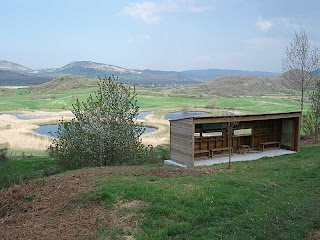
Now, with the new observatory, it is possible to take refuge the days of bad weather.

Saturday, April 21, 2007

New Records in the Yearbook.

You don’t let see the great amount of new records in:
http://www.avesdeburgos.com/anuario.htm

Black Stork, Garganey, Waders, Warblers....and more.

Tuesday, April 03, 2007

SACRE. Course


This weekend has been developed the course on the program of breeding common birds of Spain, SACRE, to carry out in the beautiful valley of Valdivielso.
The birder José Luis Lobo made the introduction to the course, along with the explanation of the program developed by SEO/BirdLife to study and to recognize the different songs from birds.
Next a stroll by the valley of Valdivielso was made, guided by the birders Josu Olavarria and Carlos Palma.
The course was very concurred, something that is really very positive.
Many species were not seen, although yes the first Short-toed Eagle Circaetus gallicus and the first Iberian Chiffchaff Phylloscopus ibericus of the season.

Sunday, April 01, 2007

Birds in Wetlands. Censuses

The census of aquatic birds that has initiated the SEO/BirdLife, does not cover all the species that are related to the wetlands, only certain species have to be registered.
The census is had to make in three times, in the second two weeks of March, April and May.
In first census, it has been made with conditions in which meteorology to play a important part.
Days back, the snow, it was making, so the level of waters of the lagoons and the rivers has grown enormously, this has made difficult to walk round these wetlands of suitably form.
Even so, the results, by this time, still early are not of all bad.
Although of the Paseriformes no has been detected, if several Ducks, and like more observed the Common Coot.
In many zones of the field still it has up to 20 cm of snow, so it seems total winter, as excellent observation but were the one of a pair of Fieldfare.

List of the species, (not exclusively records to the census).

Common Pochard Aythya ferina
Northern Shoveler Anas clypeata
Mallard Anas platyrhynchos
Common Coot Fulica atra
Great Tit Parus major
Blue Tit Parus caeruleus
Common Chiffchaff Phylloscopus collybita
netting, good moment to observe these birds, since now it is crossing towards the north of Europe.
White Wagtail Motacilla alba
Hedge Accentor Prunella modularis
Robin Erithacus rubecula
Crag Martin Ptyonoprogne rupestris
Green Woodpecker Picus viridis
Fieldfire Turdus pilaris

Wednesday, March 21, 2007

A Heavy Snowfall


When spring arrives from the calendar, it arrives the winter with snow and cold. Many of the birds that do not emigrate during the winter, have begun this year to sing early, mainly due to the smooth temperatures of second half of the winter, and some to make nests.

Several weeks ago, are listened to by the field, the songs of Robin, Great Tit, Common Chafinch, Wren, Cetti’s Warbler, Blackbird, Song Thrush, Deeper, all of them emitting their respective territorial songs of courtship and, and even carrying out persecutions, normally of males. But these days, the snow (60cm) has arrived again and the cold and those choirs have been silenced.
Bud the feeders packed of birds, the list:

Blackcap, four males and one female

Robin, lots of

Common Chafinch , lost of

Song Thrush, five

Great Tit, lost of

Blue Tit, lost of

Hedge Accentor, three birds

Grey Wagtail, one
White Wagtail, four

Wood Lark, one
Crested Lark, two birds
Black Redstart, male and female
Common Chiffchaff
European Nuthatch, two birds

Meadow Pipit, one

And the Sparrowhawk


We will have to hope again to that the temperatures activate the mechanisms of courtship of the birds and again we will have another real spring, and with all birds that arrive from Africa, Warblers, Swalows, Martins, and this will cause that he is greater the sound of the field.

Saturday, March 10, 2007

Egyptian Vulture

First bird of the season in the Zamanzas Valley, although this year has arrived a month but late that other years.


Wednesday, February 28, 2007

The Spring

The spring has arrived.
Although for the men not yet it is thus, for the nature and the birds yes.
The songs of several species of birds are listened to, Tits, Warblers, Dipper...as well as some of them are seen taking elements of construction for the nest (moss in the case of the Wren, Troglodytes troglodytes).
Also there are numerous news of migration, Geese – mainly Greylag Goose, (Anser anser), and Cranes – Common Crane (Grus grus) - towards the north of Europe and Martins and Swalows arriving from Africa, shorebirds throughout coast line and wetlands, raptors flight on the migratory road.

Wednesday, February 07, 2007

Atlas of Wintering Birds


I have finished the tracks that I have made for the Atlas of wintering birds, project in phase of test of the SEO/BirdLife.
The grid that I have selected, to be one of the same ones that I have for the accomplishment of SACRE and NOCTUA.
This zone, although is very interesting biologically, is a zone very difficult to take a census, since the habitats are varied and the displacements between and others have been enough time, as well as the effort that supposes the accomplishment of some tracks, with strong unevennesses.
The geographic position and the altitude above sea level, by these two factors, this zone tends to be of great atmospheric variability, and in winter with enough difficulty to find days adapted for the accomplishment of the censuses, if it is not raining or snowing (very probably), it is cleared, with which the mornings appear with heavy frost and mist.
Even so, the census has been productive, although I to miss some species that usually are present other years, possibly due to the high temperatures at the beginning of the winter.
I have located 41 different species, the most located Common Chafinch (Fringilla coelebs) the Great Tit (Parus major) and Jay (Garrulus glandarius).
Also Common Chafinch (Fringilla coelebs) has been most abundant, I have seen flocks of more than 100 birds.

Tuesday, February 06, 2007

Yearbook, October-December 2006


New report for finish the year 2006, it includes the records from October to December.
Click Here and click in the families
The best:
Aredeidae
Great White Egret. Egretta alba
Anatidae
Ferruginous Duck. Aythya nyroca
Accipitridae
Black-shouldered Kite. Elanus caeruleus
Lammergeier. Gypaetus barbatus
Monk Vulture. Aegypius monachus
Falconidae
Red-footed Falcon. Falco vespertinus
Lariidae
Mediterranean Gull. Larus melanocephalus
Psittacidae
Rose-ringed Parakeet. Psittacula krameri
Trichodromadidade
Wallcreeper. Tichodroma muraria
Sturnidae
Rosy Starling. Sturnus roseus

Friday, February 02, 2007

Wetlands day

Wetlands day, in the reservoir of river Ebro.


A cold day with something of mist , much snow in the field and several congealed zones of the water.


Great amount of aquatic birds, great variety of species.


Red-crested Pochard. Netta rufina and Common Coot. Fulica atra


Common Teal. Anas crecca (120 birds) and Gadwall. Anas strepera (135)


Tufted Duck. Aythya fuligula


Eurasian Wigeon. Anas penelope and Mallard. Anas platyrhynchos

Greylag Goose. Anser anser (258 birds)
Pintail. Anas acuta (17)
Northern Shoveler. Anas clypeata
Great Cormorant. Phalacrocorax carbo
Grey Heron. Ardea cinerea


Other aquatic birds


Great Crested Grebe. Podiceps cristatus (247 birds)


Black-necked Grebe. Podiceps nigricollis

Others birds


White Stork. Ciconia ciconia


Spotless Starling. Sturnus unicolor
Common Buzzard. Buteo buteo
Common Kestrel. Falco tinnunculus
Yellow-legged Gull. Larus michahellis
Green Woodpecker. Picus viridis
Robin. Erithacus rubecula
Blackbird. Turdus merula
Song Thrush. Turdus philomelos
Long-tailed Tit. Aegithalos caudatus

Links recommended

Wetlands site and the Wetlands day

SEO and the Wetlands day, and the activities form 2nd to 11th february.

Monday, January 22, 2007

Winter

Mountains and rivers in winter


One of the best times of the year to observe birds in the north of Spain is the winter.
Although sometimes, bad weather and the low temperatures can be disagreeable, is without a doubt, a good moment.


Snow on the fields


The migration is without a doubt but interesting that takes place at this time, all the birds which they wintering in Africa have left, but all the birds which breeding in the north of Europe arrive in these season in great flocks.


Waders, Ducks and Gulls in the salt marsh


The best places where to see birds, are the North Coast and all the lagoons, dams, rivers... in these places arrive Divers, Auks, Waders, Gulls, Herons, Geese, and Ducks mainly.


Velvet Scoter in Santoña marshes

Inland, forests, meadow, although can seem quiet, also they maintain a good number of species those that remain the year throughout and those that arrive flocks from Thrushes, Finches, Wagtails and Pipits.
Also it is a good moment to be able to be with less habitual species, like the Wallcreeper (Tichodroma muraria) or the Lammergeier (Gypaetus barbatus), of which there are records every year.
It is necessary to be kind to great flocks, between Greylag Goose (Anser anser)
, is not always difficult to find to White-fronted Goose (Anser albifrons)
, or other species of Geese.


White-fronted Goose in a flock of Geese


Between flocks of Thrushes, the Fieldfare (Turdus pilaris) and the Redwing (Turdus iliacus) appear all winter to us.


Fieldfare in north fields of Burgos


Brambling (Fringilla montifringilla) usually is mixed in great flocks of Finches.

Also it is possible, that in these season, we find birds that usually do not appear of constant form, rare birds that many ornithologists strive in his looks for.