Showing posts with label Ducks (Dabbling). Show all posts

Sunday, October 05, 2014

Embalse del Ebro. Acuáticas


En el oeste de Las Merindades se sitúa, compartido con la comunidad de Cantabria, el Embalse del Ebro, uno de los mejores humedales de Burgos y de Castilla y León. Aunque resulta más llamativo en los pasos migratorios y el invierno, durante todo el año se puede disfrutar de las aves que aquí se congregan.
Como venimos contando periódicamente, la comunidad de aves en el Embalse del Ebro y su entorno es variada, pero es a partir de esta época cuando se torna más interesante, pudiendo disfrutar de concentraciones de aves acuáticas  entre las que escudriñar e identificar todas las especies que ante uno se presentan, algo que en determinados momentos se torna complicado.
Por el momento, y a la espera de que las borrascas traigan, aparte de mal tiempo, más aves acuáticas como Gansos y Limícolas, la presencia de Patos es mayoritaria, hasta siete especies, y como viene siendo habitual en esta época es el Pato Colorado el que más ejemplares concentra, con más de 1000 aves.


Los pastos que circundan el Embalse recogen un buen número de migrantes, Collalbas, Alondras, Tarabillas y otras pequeñas aves…con plumajes apagados que también invitan a la identificación precisa. También la presencia de roedores hace que Busardos, Milanos y Cernícalos sean especies, en algunos momentos abundantes.


Siempre la visita al Embalse del Ebro es, como poco, esperanzador, ya que la poca afluencia, casi anecdótica, de ornitólogos, hace que pasen días,  semanas, sin saber que especies se pueden encontrar, y cuando sí hay noticias, son en muchos casos puntuales sobre una zona. La extensión del Embalse y sus alrededores hace difícil que se prospecte adecuadamente en su totalidad, por lo que siempre hay oportunidad de descubrir algo nuevo o llamativo.


Lista de Aves
Ánade Azulón (+-150)
Ánade Friso (+- 200)
Cerceta Común (26)
Ánade Rabudo (2)
Cuchara Europeo (6)
Pato Colorado (1300)
Silbón Europeo (2)
Somormujo Lavanco (40)
Zampullín Cuellinegro (6)
Cormorán Grande
Garzeta Grande
Garceta Común
Garza Real
Espátula
Aguilucho Lagunero
Busardo Ratonero
Cernícalo Vulgar
Focha (+-400)
Avefria
Gaviota Reidora
Gaviota Patiamarilla
Martín Pescador
Alondra
Bisbita Alpino
Lavandera Blanca
Tarabilla Norteña
Tarabilla Común
Collalba Gris
Mirlo Común
Urraca
Corneja Negra
Cuervo
Jilguero
Pardillo

34 especies en un par de horas y prospectando menos del 5% del Espacio Natural.

Actualización 11/12/14 

Lista de Aves
Ánade Azulón (+-360)
Ánade Friso (+- 180)
Cerceta Común (150)
Ánade Rabudo (1)
Cuchara Europeo (40)
Pato Colorado (1700)
Silbón Europeo (10)
Somormujo Lavanco (80)
Zampullín Cuellinegro (1)
Cormorán Grande
Garzeta Grande (6)
Garceta Común (1)
Garza Real (30)
Espátula (24)
Busardo Ratonero
Cernícalo Vulgar
Focha (+-200)
Archibebe Común (2)
Correlimos Común (15)
Aguja Colinegra (5)
Gaviota Reidora (70)
Gaviota Patiamarilla (45)
Alondra
Bisbita Pratense
Lavandera Boyera

Tarabilla Común
Mirlo Común
Urraca
Corneja Negra
Estornino Negro


Tuesday, March 24, 2009

Lagoon of Miranda de Ebro


The province of Burgos is not characterized to have many wetlands, but the few that it has are really interesting.
One of that I have followed since I began with birdwatching is the lagoon complex next to the city of Miranda de Ebro.
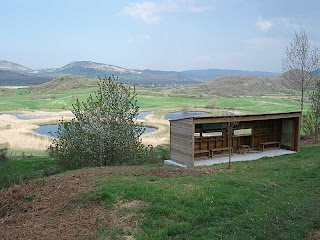
Three small lagoons very next to the city and surrounded by highways, but that even so are able to lodge a good amount of species of birds. Luckily, from year 2002 a good sum of money has been reversed to prepare them, and now one of them has an observatory.
These lagoons were on the verge of disappearing, as it happened with other many in Spain, used like tip, burned the vegetation…
Now it is possible to be enjoyed a good number of birds and the proximity to the city causes that they are possible to be used by the schools to bring back to consciousness to the children and to teach to them to the importance of the water, wetlands and birds.
The other day in a two hours I could see the next birds:

Mallard
Northern Shoveler
Common Buzzard
Great Cormorant
Eurasian Coot
Common Moorhen
Corn Bunting
Common Red Bunting (3)
Marsh Harrier (1)
Common Snipe (16)
Barn Swallow
Cetti’s Warbler
Magpie
White Stork
European Greenfinch


Friday, March 06, 2009

A new little wetland

Mario Alonso Blanco, to discover for the ornithological community a new little wetland in the outskirts of Villarcayo town.
This it is very interesting so that in the province of Burgos there are not many wetland, which makes difficult the establishment of own species of these zones.
Even so, in dams and gravel pits, there have been very interesting records, although with very few settlement birds permanently.
The small lagoon, forms next to a farm, and it is dried in summer, reason why it will not be able either to have species all year, but during the winter it becomes a rest area for migratory birds.
Also it owns a quite great colony of White Stork.

These days:
Greylag Goose
Common Shelduck
Common Teal
Mallard
Northern Shoveler
Northern Lapwing
Great flocks of Common Starling
White Stork
Black-headed Gull

Monday, December 29, 2008

SACRE in Winter

This it is the first year that I realise the route for the new program for the follow-up of birds of SEO BirdLife, the follow-up of common birds in winter. (More here)
The squares it’s the same that I realise in spring, VN 4040.
The route is simple, and I have chosen to realise it by two zones easy to walk and very pretty, the pastures of the Valley of Zamanzas and the footpath GR 99 throughout the river Ebro.
In this zone the river Ebro has very well conserved banks, where the alders abound, ashs, poplars…
A good number of birds and species, 29, but certainly throughout the years this will change.

Here you have the relation of species seen in two hours:

Mallard, Grey Heron, Griffon Vulture, Common Buzzard, Common Kestrel, Blue Tit, Great Tit, Long-tailed Tit, Fieldfare, Song Thrush, Mistle Thrush, Blackbird, European Robin, Wren, European Serin, Eurasian Bullfinch, Hawfinch, Common Chaffinch, Eurasian Siskin , Green Woodpecker, Blackcap, White Wagtail, Dipper, Spotless Starling, Red-billed Chough, Carrion Crow, Jay, Eurasian Nuthatch, Wood Pigeon.

Sunday, November 18, 2007

56 Birds Species

After the news appeared in the forum of Cantabria, we have gone, David González Ortega (Burgos yearbook coordinator) and I , in search of Rock Pipit in the water reservoir of river Ebro, these have not appeared, all the observed ones have been Meadow Pipit,
but we has been a good day of observations, great flocks of Black-necked Grebe, Ducks (8 different species) and five species from waders.
Some remarkable records, Lesser Black-backed Gull, Red Knot and Golden Plover.
At the end of the day a flock of Fieldfare feeding berries of Common Hawthorn.


The bird list of the day:

1.-Greylag Goose Anser anser, a rough estimate, 500 birds
2.-Eurasian Wigeon Anas penelope
3.-Gadwall Anas strepera
4.-Common Teal Anas crecca
5.-Mallard Anas platyrhynchos
6.-Northern Shoveler Anas clypeata
7.-Common Pochard Aythya ferina
8.-Tufted Duck Aythya fuligula
9.-Great Crested Grebe Podiceps cristatus
10.-Black-necked Grebe Podiceps nigricollis, likely the record with the bigger flock with 127 birds.
11.-Little Grebe Tachybaptus ruficollis
12.-Great Cormorant Phalacrocorax carbo
13.-Great White Egret Casmerodius albus, 3 birds
14.-Grey Heron Ardea cinerea
15.-Red Kite Milvus milvus
16.-Griffon Vulture Gyps fulvus
17.-Common Buzzard Buteo buteo

18.-Comon Krestel Falco tinnunculus
19.-Peregrin Falcon Falco peregrinus
20.-Common Coot Fulica atra
21.-European Golden Plover Pluvialis apricaria
22.-Northern Lapwing Vanellus vanellus
23.-Red Knot Calidris canutus, 1 bird
24.-Dulin Calidris alpina, 6 birds
25.-Green Sandpiper Tringa ochropus, 2 bird
26.-Black-headed Gull Larus ridibundos
27.-Black-backed Gull Larus fuscus, 1 bird
28.-Yellow-legged Gull Larus michahellis
29.-Common Woodpigeon Columba palumbus
30.-Eurasian Collared Dove Streptopelia decaocto
31.-Common Kingfisher Alcedo atthis
32.-Meadow Pipit Anthus pratensis
33.-White Wagtail Motacilla alba
34.-Wren Troglodytes troglodytes
35.-Robin Erithacus rubecula
36.-Black Redstart Phoenicurus ochruros
37.-Blackbird Turdus merula
38.-Fieldfare Turdus pilaris , 50 birds
39.-Redwing Turdus iliacus
40.-Cetti's Warbler Cettia cetti
41.-Common Chiffchaff Phylloscopus collybita
42.-Long-tailed Tit Aegithalos caudatus
43.-Coal Tit Parus ater
44.-Great Tit Parus major
45.-European Nuthatch Sitta europaea
46.-Short-toed Treecreeper Certhia brachydactyla
47.-Southern Grey Shrike Lanius meridionalis
48.-Magpie Pica pica
49.-Carrion Crow Corvus corone
50.-Common Raven Corvus corax
51.-Common Starling Sturnus vulgaris
52.-Spotless Starling Sturnus unicolor
53.-House Sparrow Passer domesticus
54.-Common Chaffinch Fringilla coelebs
55.-Goldfinch Carduelis carduelis
56.-Common Bullfinch Pyrrhula pyrrhula

Thursday, May 03, 2007

Yearbook, January-March 2007


Updated the Ornithological Yearbook of the province of Burgos , with the new report of January, February and March with interesting records of wintering and migrate birds .

Mandarin Duck (Aix galericulata )
Garganey (Anas querquedula)
Monk Vulture (Aegypius monachus)
Spanish Imperial Eagle (Aquila adalberti )
Hoopoe (Upupa epops)
Black Woodpecker (Dryocopus martius )
......
Also interesting records in the home page.

Friday, April 27, 2007

Lagoons


Great number of migratory birds has arrived, in a stroll by the lagoons of Gayangos it is possible to see and to listen many of these birds.
The lagoons of Gayangos conform one of the few wetlands of the province of Burgos.
They are composed by three main lagoons and other than is stationary because it is dried at times of summer.
In these lagoons it is possible to find great number of species of birds, being the most showy aquatic birds, Ducks, Grebes, Rails…and those that live related to the wetland plants, Cetti’s Warbler, Great Reed Warbler….

Garganey

Several of the birds that live in the wetlands plants are difficult to detect if it is not by means of the voice.
In the environs of the lagoons it is possible to see other many species of birds, Buntings, Stonechats, Finches, Kites, Storks

Corn Bunting

Whinchat
Now, with the new observatory, it is possible to take refuge the days of bad weather.

Saturday, April 21, 2007

New Records in the Yearbook.

You don’t let see the great amount of new records in:
http://www.avesdeburgos.com/anuario.htm

Black Stork, Garganey, Waders, Warblers....and more.