Friday, August 25, 2006

A Juvenile Griffon Vulture


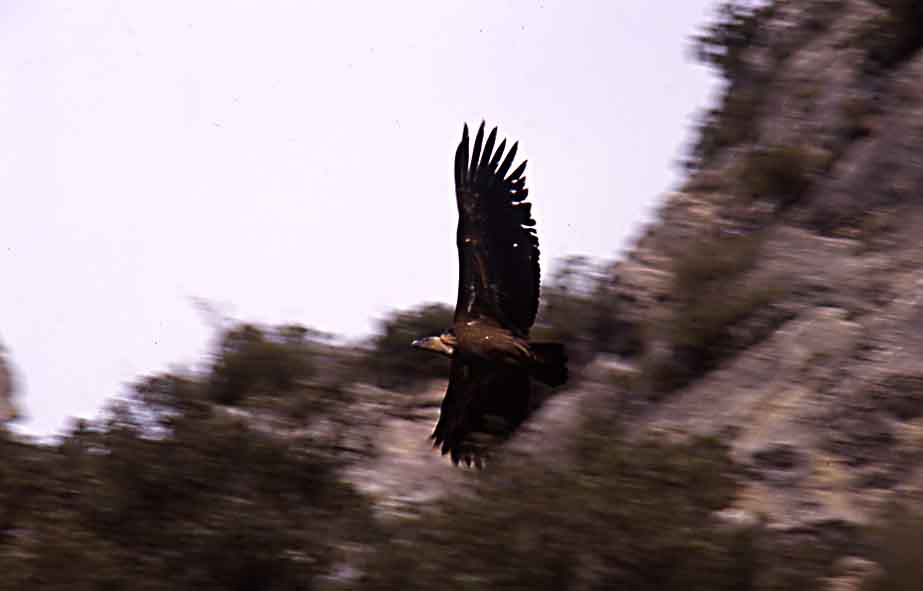
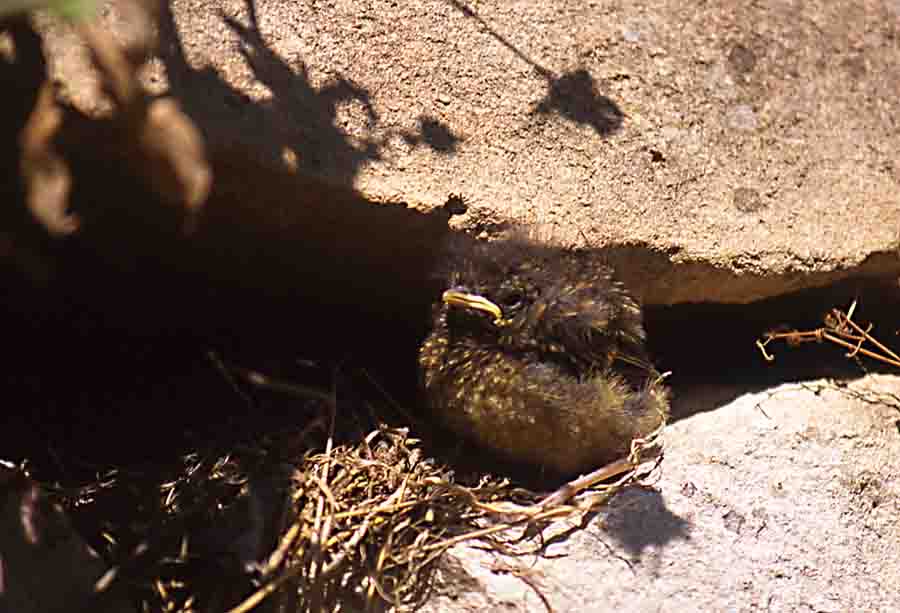
Every year, usually is normal to see juvenile of Griffon Vulture (Gyps fulvus), that they are undernourished and they fall to the ground, in places where soon it is very difficult to them to overcome the flight.
This undernourishment must mainly to the lack of food, so that they do not find the juvenile birds of easy form.
Thus we were every year with birds in the most unsuspected places, in the trees of the shore, upon a stone next to the river, in roads..., birds that, in many cases, let themselves take since they do not have forces to escape.
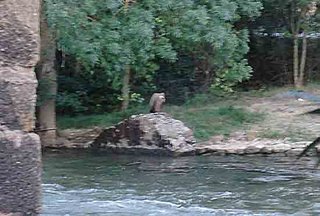
In this case a juvenile of Griffon Vulture, to fallen to the border of the river, and to passed everything afternoon to get on a stone.

Sunday, August 20, 2006

New report of the Yearbook

The new report of the more interesting birds can already be consulted that the birders of Burgos have seen during last the three months, April, May and June.
Second report of the Yearbook of the Birds of Burgos

In this new report the observations is remarkable the breeding of Grey Heron (Ardea cinerea), and the records of Ruddy Shelduck (Tadorna ferruginea), three records of Lammergeier (Gypaetus barbatus), Whiskered Tern(Chlidonias hybrida),
Black Woodpecker(Dryocopus martius), Wallcreeper (Tichodroma muraria) and more...

You can find the first report for the January, February and March, Here

Thursday, August 17, 2006

I and the Bird #30 by Burning Silo

I and the bird #30

Thursday, August 03, 2006

I and the Bird #29 by Alis Volat Propiis

I and the Bird #29

Thursday, July 27, 2006

Wonderful Visitors


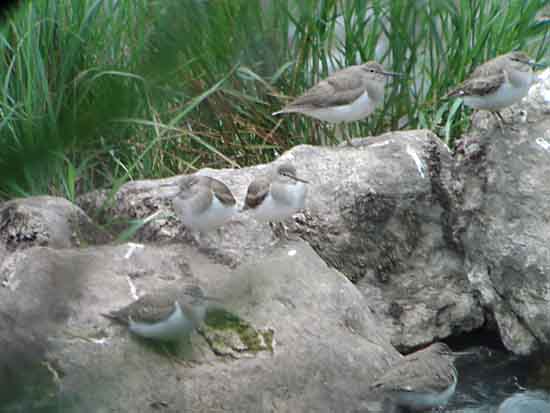
This week we have had the visit of a group of 13 Common Sandpiper (Actitis hypoleucos) , that are been spending several nights, resting in the dam of the Mill, the group this made up of several adults and juveniles birds.
Not very often so numerous groups of this species see themselves.

The Common Sandpiper are one of the species of waders more common in the Iberian Peninsula interior, very being bound to the watercourse.
His identification is simple, in adult in breeding plumage, brown upperparts; tertials, scapulars and wing coverts have dark brown shaft streaks and bars, with buff tips. Bill dark brown. Legs usually greenish-grey. The juvenile plumage is similar to non-breeding plumage in adults, mantle and scapular feathers are a warm brown, with shaft streaks and subterminal lines.


Junenile and Adult mantle plumage

His behavior also is very characteristic.
Teeters constantly, habitually bobbing its head and pumping the rear part of the body up and down.
In flight they make alternating bursts of stiff wing-beats and short glides, just above the surface of the water, with bowed wings.


During these days that are been this way have by day been during long time emitting as much as at night one of their classic calls.

Sunday, July 23, 2006

The Juveniles Birds

As I already commented in my previous post, it is time to see mainly juveniles of the different species of birds, yesterday after a route by the center of the “Las Merindades “, were possible to be observed quite a lot species.
The presence of juvenile birds, with its plumages different from the adult was remarkable, Great Tit (Parus major) , European Stonechat (Saxicola torquata) , Whinchat (Saxicola rubetra) , House Martin (Delichon urbicum) ,Barn Swallow (Hirundo rustica), Finches....
One of the most spectacular juveniles birds was the Egyptian Vulture (Neophron percnopterus), a totally black juvenile, very different from the adults, also the head differs in the color, yellow in the adult and bluish in the juvenile.
In a distance, a inexperienced observer, can to mistake by Black Vulture.


A juvenile birds of Goldfinch, Coot and Egiptian Vulture

Thursday, July 20, 2006

I and the Bird #28 by Bogbumper

I and the Bird #28

Sunday, July 16, 2006

"Easy Path of Castilla y León"


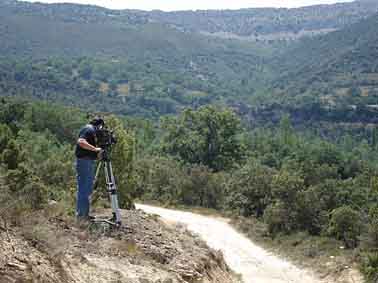
This week the TVE (Spain television) is been recording an interview, in the Inn, the author of the book “SENDEROS FÁCILES POR CASTILLA Y LEÓN", Javier Prieto, a book on routes and ways of Castile and León .


Among the outstanding routes one is a very near one the Molino del canto Inn, the one that runs by the Canyon “Los Tornos”, and that begins in the village of Tudanca.
In a future post I will describe this route of detailed form more.
It is a section of the GR85 that crosses great part of the north of Burgos province.


They have arrived at the zone to take images from the route for the small accomplishment from a documentary one, and have made some interviews, a pair of them to the own author of the book and another they did me my, in relation to the species of birds that live and that can be observed in this zone of the north of Spain.
The birds that could be observed during the route, were mainly Griffon Vultures (Gyps fulvus), although also the rest of the species was seen an Egyptian Vulture (Neophron percnopterus), were forest, Tits, Wagtails, Western Bonelli’s Warbler (Phylloscopus bonelli), but it is already very evident that the birds have been stop sing as intensely as for some weeks, now easiest to see and to listen it is to great amount of young birds of different species, persecuting from the parents so that they give food them.
By this it is a good moment to be able to observe the different types from plumage that have the birds with youthful age, sometimes very different from the plumage of the adults.

Friday, July 07, 2006

The Jay (Garrulus glandarius)

The other day my girl found a Jay (Garrulus glandarius) died in the road, something commonest of that we can imagined, it is difficult to know the number of birds that die in the highways of Europe, but surely that is elevated.
It is not easy to observe the Jays in the forests, is an evasive bird, which does not let itself see much, but if to listen, in a small route by any forest it is easy to listen to several times the rough calls of these birds.
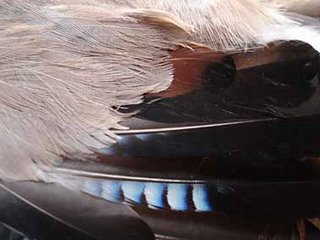
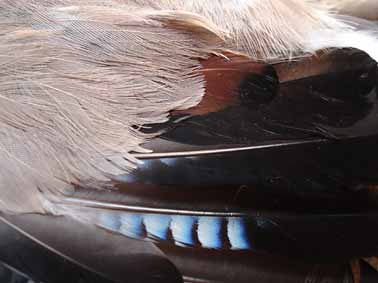
Although it is not the first time, I could again observe with detail the wonderful characteristics of the plumage of the Jay, emphasizing the primary coverts, feathers without a doubt of prettiest of the European birds.


Primary coverts

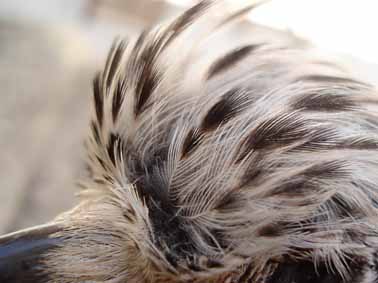
Also she observes in the head the feather of the crown, same that raises as a crest, and the characteristic moustache support.


Crest

Other spectacular feather are the tertials , of colour it rusts and those of colour salmon of the mantle.


Mantle of Jay


Tertials

As it is possible to be seen, a so common bird but simultaneously one of the birds more spectacular than lives in the environs.
It is easy to observe like at time of nuts, the Jays gather nuts of the trees later to bury them in places where they to think that they will remember, but the recoveries of buried nuts are small.
This the best friend of the forest does of the Jay.


walnut tree born under yew tree


Distribution of Jay in the Burgos province.
Map of the book: Atlas de las Aves Nidificantes de la Provincia de Burgos.Román, J., Román, F., Ansola, L.M., Palma, P., Ventosa, R.. (1996)

Thursday, July 06, 2006

I and the Bird #27 by 10,000 Birds

I and the Bird #27

Friday, June 30, 2006

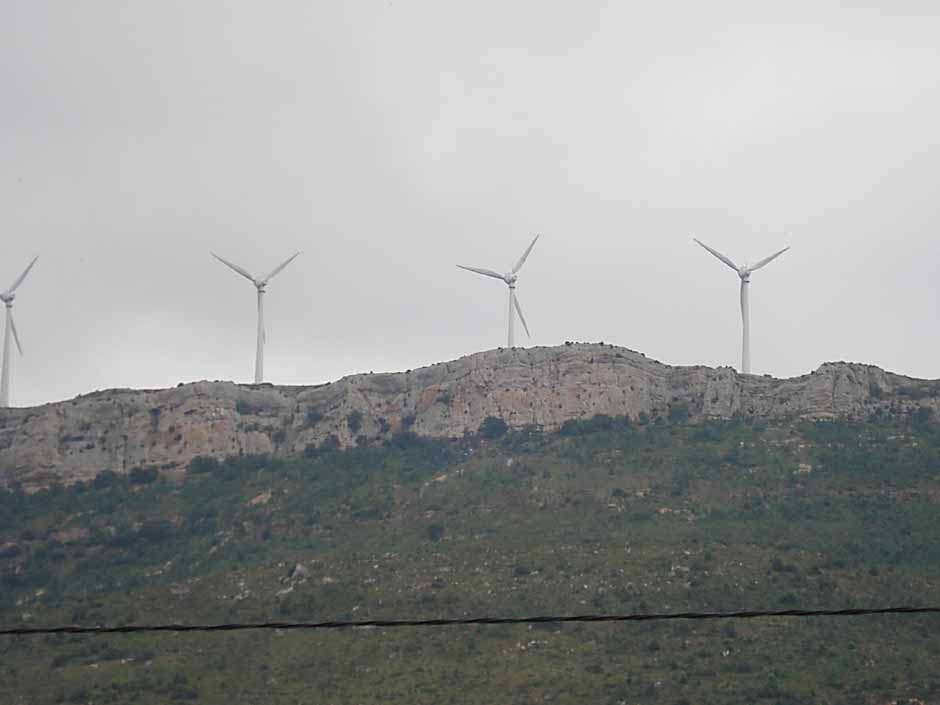
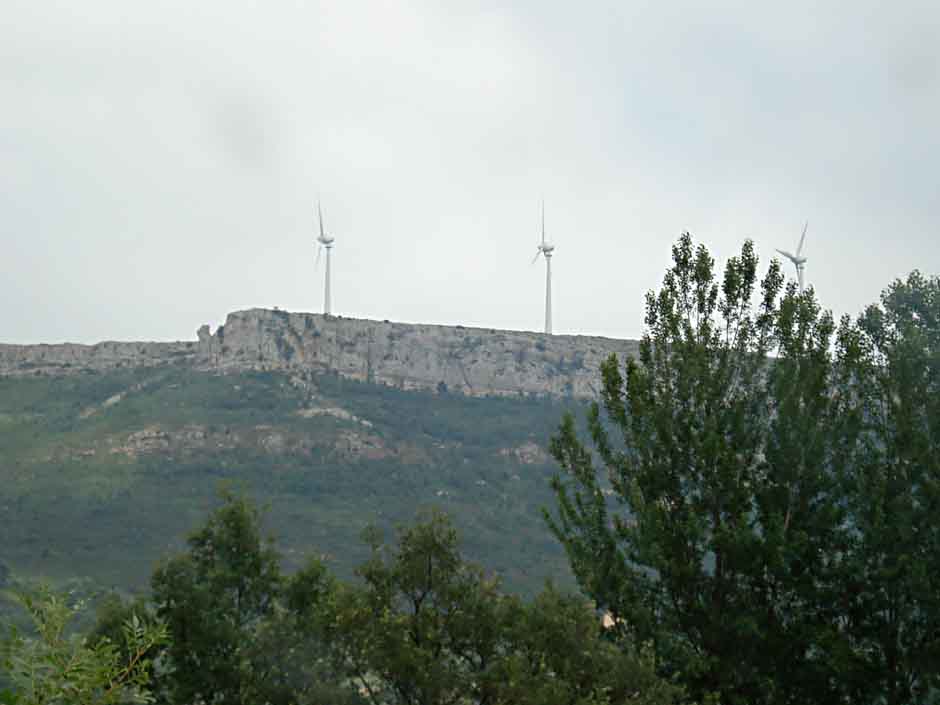
Windfarms

The last news on the collisions of birds in the windfarms are terrible, many White-tailed Eagle
died in Norway, Golden Eagles in Scotland (article) and here in Spain, they do not stop of news about dead of Eagles and Vultures.
The bad location of this type of energy is taking to a serious environmental problem, with one serious incidence in the populations of birds, many of these already threatened and in serious danger.
Even so this type of energy generation is continued with publicity like energy that respects the environment, something that this very far from the reality.
Here in the north of Spain the windfarms location cannot be more ominous, just in mountain summits, where the Griffon Vultures, and Eagles finds the currents thermal that they use in his flights.
In other cases these are in migratory routes where the collisions are frequent.
In 1970, the Griffon Vulture was in clear regression, is very possible that this situation we return it to live, single that now, with the destruction of its environment the recovery will be impossible.
A clear disappearance of the Egyptian Vulture is already being seen.
To the problems that produce the windfarms we can add the disappearance of the carrion of cattle origin that before found these birds.

You can find articles about the birds and windfarms in

iberica 2000.org

Wednesday, June 28, 2006

The SACRE Program II

After making the second route to the grids that I have assigned, it’s to make up books of the found species.
The routes have been made with good weather.
In grid VN44 I have located 62 different species and in the VN34, 54 were located, a clear difference because in the VN44 there is more variety of habitats and this is equivalent to a greater diversity of species.
Altogether 71 different species have been located, being located, the Common Cuckoo, excepting an observation of a concentration of approximately 100 Common Swift, as if they were in migration.
Birds that have been located for the first time:
Black-winged Stilt
Common Quail
Lesser Spotted Woodpecker
Wood Lark
Spectacled Warbler

In grid VN44 stays within the values of other years with maximums of 65 and minimum of 51.

SACRE program

Thursday, June 22, 2006

I and the Bird #26 by The Hawk Owls' Nest

I and the Bird #26

Tuesday, June 20, 2006

About Swifts, House Martins & Swallows

The past day 05/26/2006 in Birds in the North of Spain , this post made reference to one of the more specialist birds, the Common Swift.
Along with the House Martins and Swallows have been of the birds that more near the man live, and have come using for many years the human constructions to nest.
But now its future is uncertain, and the last studies indicate that their populations are lowering in all Europe (for further details here), mainly seems that by the agricultural changes and changes in their habitual places of nest.

In the construction of new buildings or the reconstruction or renovation of the old, one does not consider, that this being avoided that these birds nest.
New systems of roofing tiles, elimination of eaves, closing of attics...., all this do that these birds do not find good places of nest between us.
For that reason we must make an effort and to try that, when you are made east type of works install new systems that allow to the installation of these birds and their conservation. You can find information about the diferents SCHWEGLER systems here Flyer (PDF)
If some summer we do not return to listen to the precious sound of the Common Swifts, will be the saddest summer.

More information in:
http://www.charliesbirdblog.com/ (June 13 2006: Conservation of Common Swifts...)
London's Swifts Homepage


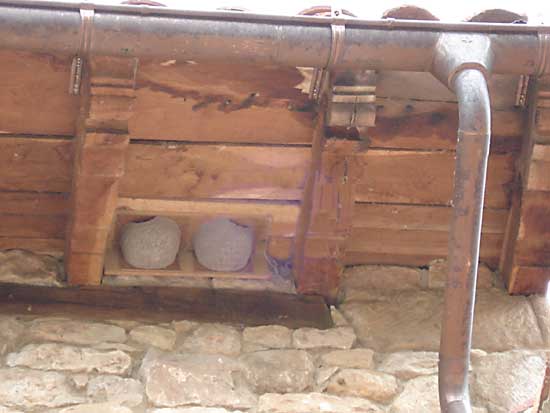
House Martin double nest of Schwegler in the eaves of the Molino del Canto Inn

Friday, June 16, 2006

The birds from the Garden III

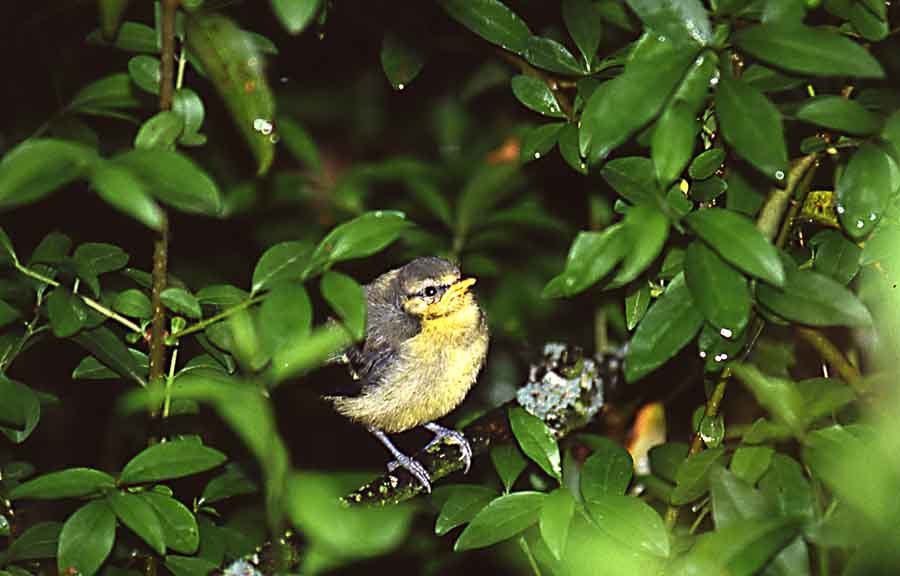
The Great Tit and Blue Tit begin more continuously to use the feeders, by which they see themselves with more assiduity.

Under the feeders isn’t difficult to find Common Chaffinch and Greenfinch, gathering the seeds of the ground
.
One becomes to listening to the Iberian Chiffchaff, and from time to time to listen the Common Chiffchaff .
Wren and Blackcap, easily locatable in the thickness of the shrubs.
On the trunks of the trees, the Short-toed Treecreeper and its acute call. And like specially showy bird that visits the garden every year, Common Redstart, a precious male singing searching a female.

Wednesday, June 14, 2006

Trip from North to South

A pretty week crossing Spain, from the north to the south, and crossing some of the natural spaces of Spain.
The first shutdown we did it in the National Park of Daimiel, natural space created by the confluence of two rivers, Cigüela and Guadiana.
This National Park, like the average Spain, is affected by drought and the little conscience of the people who live in the environs.
The aquatic birds, almost do not appear, since 2% of the floodable area are only flooded.
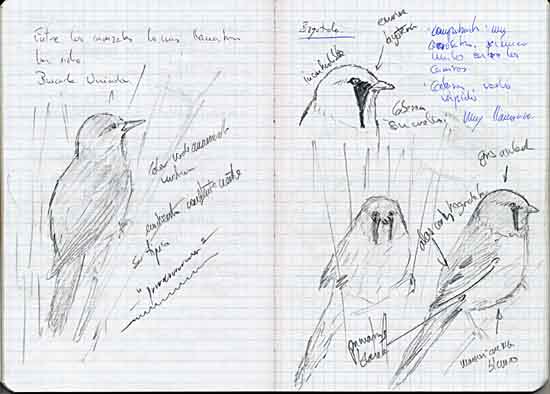
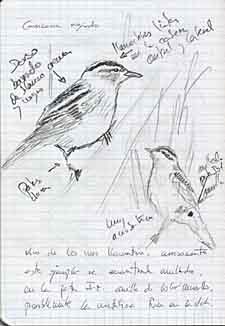
So the birds that live in the reeds, are the unique ones that cheers the visit, the most showy species were, Bearded Tit, Savi´s Warbler and Aquatic Warbler. Other observed species in el National Park.


Savi´s Warbler and Bearded Tit in the Field Notebook

Great Spotted Cuckoo
Common Swift
Common Wood-Pigeon
Eurasian Hoopoe
Common Redshank
Pied Avocet
Black-winged Stilt
Whiskered Tern
Cetti's Warbler
Eurasian Reed-Warbler
Great Reed-Warbler
Common Nightingale
Crested Lark
Yellow Wagtail
Magpie


Acuatic Warbler in the Field Notebook

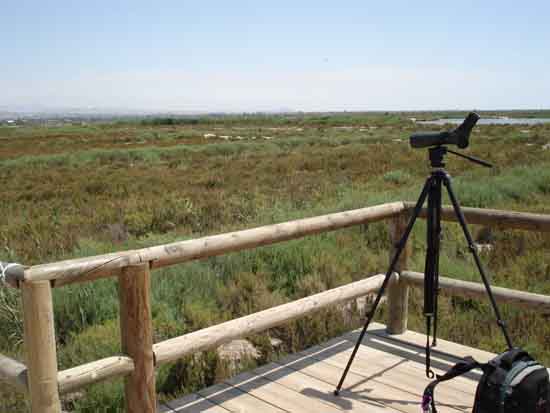
Later we followed course the south, again it is possible to be verified as the lack of water and mainly badly the use of the water this being an increasing problem. We arrived the Natural Space Cabo de Gata, with several remarkable points: The Rambla Morales, coastal lagoon of doubtless value by the presence of White-headed Duck.
The salt pan of Cabo de Gata, one of the most interesting points for the observation of Greated Flamingo and is not difficult to see birds rings.


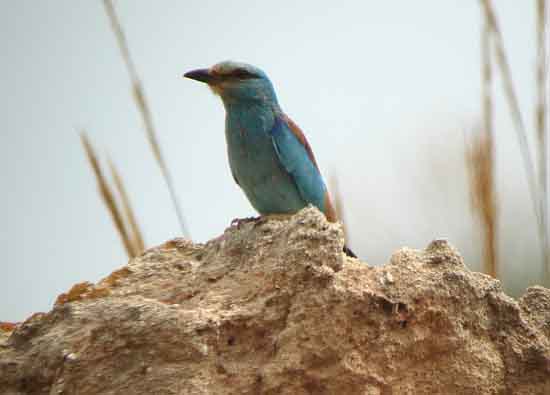
The gullies of Cabo de Gata, places in which still it is possible to find really showy species like the Lesser Short-toed Lark, European Roller or the European Bee-eater.
Birds observed in all Natural Space of Cabo de Gata.

Greated Flamingo
Eurasian Wigeon
Mallard
Common Pochard
White-headed Duck
Eurasian Hoopoe


European Roller
European Bee-eater
Great Spotted Cuckoo
Common Swift
Pallid Swift
Little Owl
Common Wood-Pigeon
Common Coot
Common Moorhen
Sanderling
Little Stint
Common Redshank
Common Ringed Plover
Kentish Plover
Eurasian Oystercatcher
Black-winged Stilt
Pied Avocet
Audouin's Gull
Whiskered Tern
Yellow-legged Gull
Slender-billed Gull
Black-headed Gull
Little Tern


Gull-billed Tern
Black Kite

Common Kestrel
Little Grebe
Grey Heron
Little Egret
Woodchat Shrike
Carrion Crow
Eurasian Jackdaw
Magpie
Black Wheatear
Spotless Starling


Lesser Short-toed Lark and White-headed Duck in the Field Notebook

Lesser Short-toed Lark
Crested Lark
Thekla Lark
Yellow Wagtail


Other visited natural spaces in the Southeast, the salt pans of Santa Pola where the Greated Flamingo ones were observed again.
Yellow-legged Gull
House Sparrow
Great Reed-Warbler
Little Egret
Purple Heron
Greater Flamingo
Great Crested Grebe
Black-winged Stilt
Pied Avocet
Whiskered Tern
Sand Martin

El Hondo area of reedbed partially flooded with cleared sand areas.

Birds observed in El Hondo area

Collared Pratincole
Yellow Wagtail
Black-winged Stilt
Pied Avocet
Little Grebe
Little Tern


Squacco Heron
Thekla Lark
Grey Heron
Corn Bunting
Black-headed Gull
Common Coot
Zitting Cisticola
European Honey-buzzard
Again the problem of the bad management of the water maintains this natural space on the brink of disappearance and again the golf courses and the urbanizations proliferate by all the coast

Thursday, June 08, 2006

I and the Bird #25 by Rob's Idaho Perspective

I and the Bird #25

Thursday, June 01, 2006

Chicks Season

During this time, when we left to see birds is easy to find birds that can seem us strange and unusual plumages, but far from being rare birds, we were at the time at which there is a great amount of chicks that begin his first flights, normally behind the kind parents.
We can see the typical chicks plumages, normally very similar to those of the females, of dull tones and nothing showy, so that they happen very unnoticed before possible predators.
Also its behavior is in showy general like clumsiness in flight or the lack of experience before a possible predator, which easily sees when before us, is almost without fear and even onlooker.
In the environs of Molino del Canto Inn , chickens of, Thrushes, Warblers, Finches, Tits…. can be found like more common birds.

Wednesday, May 31, 2006

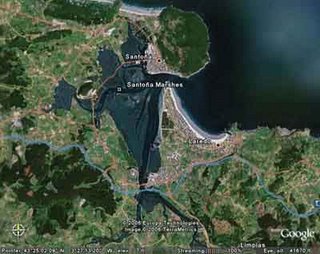
Birding Site of the Month:The Santoña Marshes

One of the most important places of the North coast of Spain, marsh of 3,500 ha. of extension, declared Natural Reserve, ZEPA and RAMSAR place, is in the union of estuary of Limpias, Rada, Escalante and Argoños.
There are spacious surfaces of muds, sandy grounds and marshes.
There are two factors that regulate the presence and distribution of the birds, first is the stations of the year, being the winter when the greater number of birds is reached as much, as of species, more than 20,000 birds and 121 species.
The other factor that affects to the distribution of the birds by the marsh is the tidal regime, that regulates the areas where the birds feed or rest.
The best moment to observe birds is between two hours before and after the high water.
The Santoña Marshes count have their importance in the wintertime and the migratory step for numerous species of Ducks, Herons, Gulls and Waders . Although at reproductive time and as it happens in the rest of the Cantabrian coast does not host important contingents of reproductive birds, two species they do of this singular place: the Purple Heron and the Little Bittern.
The winter is the best time for birdwatching; from November to March they are possible to be found near 57 species that they emphasize by his number the Widgeon (2,500 birds) and the Dunlin (5-6,000 birds), but without a doubt what attracts the majority it is to be able to contemplate those species of the north of Europe than all winters to arrive to Santoña Marshes: Great Northern Diver, Red-throated Diver, Black-throated Diver, Slavonian Grebe, Common Scoter, Velvet Scoter, Eider…

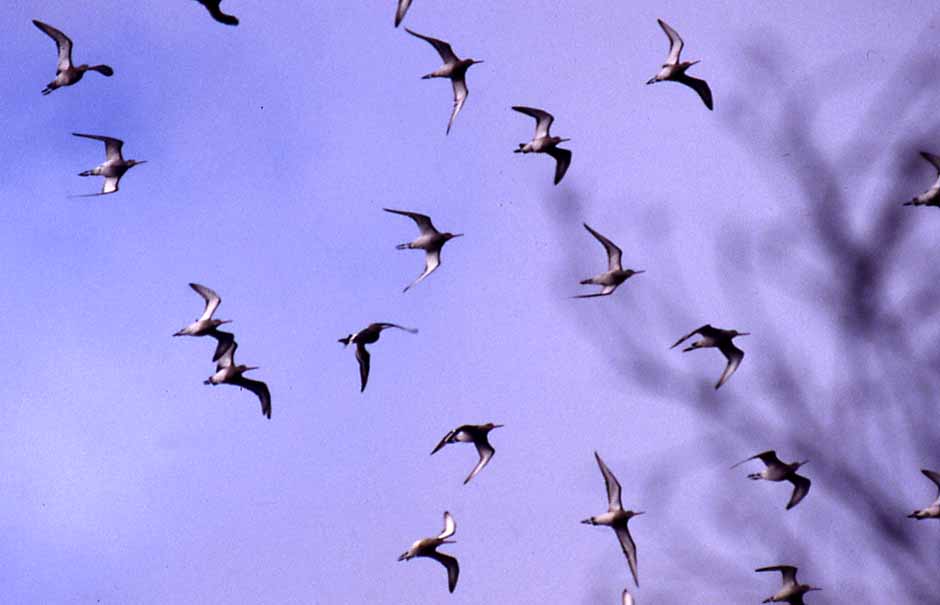
Black-tailed Godwit

Main summer species , present mostly in breeding period, spring and summer.

Little Grebe
Shag
Purple Heron
Little Bittern
Gadwall
Mallard
Wigeon
Water Rail
Common Coot
Moorhen
Peregrine Falcon
Little Ringed Plover
Sardinian Warbler

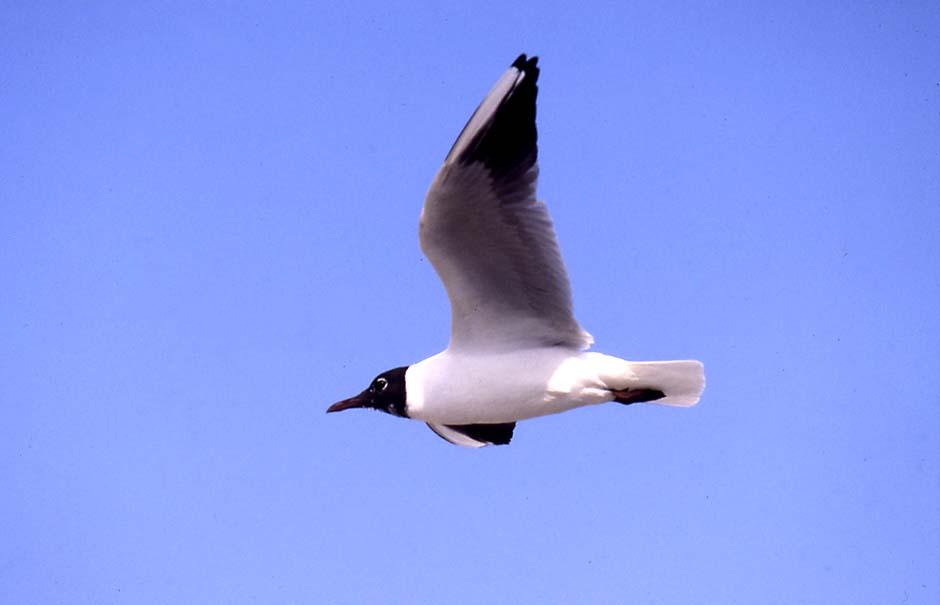
Black-headed Gull

Main winter species, present only between autumn and spring.

Great Northern Diver
Black-necked Grebe
Red-necked Grebe
Great Crested Grebe
Spoonbill
Grey Heron
Little Egret
Eider
Common Scoter
Brent Goose
Greylag Goose
Red-breasted Merganser
Widgeon
Oystercatcher
Grey Plover
Dunlin
Ringed Plover
Black-tailed Godwit
Bar-tailed Godwit
Redshank
Greenshank
Curlew
Whimbrel
Sándwich Tern
Yellow-ledged Gull
Lesser Black-backed Gull
Mediterranean Gull
Black-headed Gull
Guillemot
Razorbill

More information about the Santoña marshes: Here

Friday, May 26, 2006

The Sound of Summer

There are two birds that when I listen to them, I think that definitively the summer has arrived, one of them, it is easy to listen in cities, towns, and villages, is the Common Swift, impressive its flights between the buildings, their persecutions and mainly the high-pitched voice incessantly emitted.
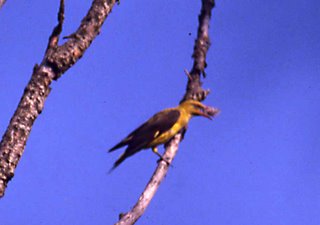
The other species is the Golden Oriole, bird that finishes arriving from Africa and that mainly in the borders of the rivers with trees is possible to listen to the wonderful song of the male and the shrill answer of the female.
The two species are present in the environs of the Mill of Canto Inn, and easily it is possible to be enjoyed the flights of the Common Swift, not that easy is to be able to see it movements of the Golden Oriole, its green and yellow plumages they are camouflaged perfectly between the trees.