Showing posts with label Storks. Show all posts

Wednesday, April 28, 2010

April in Burgos

Interesting first days of April in Burgos, apart from the arrival of numerous African Birds, there is a good number of birds records, especially remarkable, less common birds in Burgos, I put some for you.

- Night Heron (Nycticorax nycticorax). 11-04-10 - Santillán del Agua (Fernando Román Sancho). Burgos, 12-04-10 (Gema Ortega, Roberto Milara) , Lerma 18-04-10 (Alfonso Antón, Fernando Román). 24-04-10 Villatuelda (José Luis Silva).

- Cattle Egret (Bubulcus ibis). Villadiego 02-04-10 (Nicolás Gallego Rojas). 05-04-10 Lerma (Alfonso Rodrigo García).

- Purple Heron (Ardea purpurea). 12-04-10 Burgos (Gema Ortega, Roberto Milara). 13-04-10 Tordueles (Alfonso Antón).

- Black Stork (Ciconia nigra). 16-04-10 Villarcayo (Josu Olabarria Bastida).

- Eurasian Spoonbill (Platalea leucorodia). 18-04-10 Grijalba (Carlos Palma Barcenilla).

- Black-shouldered Kite (Elanus caeruleus). 26-04-10 Torrecilla del Monte (Fernando Román Sancho).

- Monk Vulture (Aegypius monachus). Tubilleja (Javier Lamas Sierra). 08-04-10 en Báscones del Agua (Alfonso Rodrigo García). 24-04-10 Hozalla de Losa (José M. Vadillo).

- Osprey (Pandion haliaetus). 01-04-10 La Puebla de Arganzón (Javier Lamas Sierra). 10-04-10 Ura (Alfonso Antón).

- Black-billied Sandgrouse (Pterocles orientalis). 01-04-10 La Sequera de Haza (Alfonso Antón, Fernando Román Sancho).

- Avocet (Recurvirostra avosetta). 18-04-10 Arlanzón water reservoir (Julio César Amo Fernández).

- Little Stint (Calidris minuta). 19-04-10 Atapuerca (Alfonso Rodrigo García).

- Mediterranean Gull (Larus melanocephalus). 27-03-10 Ebro water reservoir (Manuel Estébanez Ruiz).

- Whiskered Tern (Chlidonias hybrida). 18-04-10 Ebro water reservoir (Manuel Estébanez Ruiz).

- Red-rumped Swallow (Hirundo daurica). 24-03-10 Quintanilla del Agua (Alfonso Antón).

- Black Wheatear (Oenanthe leucura). 01-04-10 Milagros (Alfonso Antón, Fernando Román Sancho).

- Ring Ouzel (Turdus torquatus). Palacios de la Sierra 28-03-10 (Sonia Martín Gómez). Peña Ulaña 03-04-10 (Justina Pérez Martín). Ordejón de Arriba, Peña Ulaña 03-04-10 (Agustín Salazar Celis). 10-04-10 Corralejo (Agustín Salazar Celis).

- Sedge Warbler (Acrocephalus schoenobaenus). 18-04-10 Sasamón , Grijalba (Carlos Palma Barcenilla). Atapuerca (Alfonso Rodrigo García).

- Wallcreper (Tichodroma muraria). 11-04-10 (José M. Vadillo).

More information HERE

Tuesday, March 24, 2009

Lagoon of Miranda de Ebro


The province of Burgos is not characterized to have many wetlands, but the few that it has are really interesting.
One of that I have followed since I began with birdwatching is the lagoon complex next to the city of Miranda de Ebro.
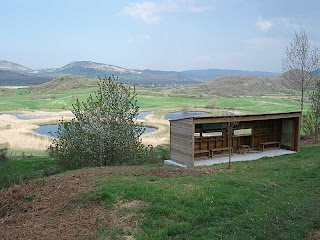
Three small lagoons very next to the city and surrounded by highways, but that even so are able to lodge a good amount of species of birds. Luckily, from year 2002 a good sum of money has been reversed to prepare them, and now one of them has an observatory.
These lagoons were on the verge of disappearing, as it happened with other many in Spain, used like tip, burned the vegetation…
Now it is possible to be enjoyed a good number of birds and the proximity to the city causes that they are possible to be used by the schools to bring back to consciousness to the children and to teach to them to the importance of the water, wetlands and birds.
The other day in a two hours I could see the next birds:

Mallard
Northern Shoveler
Common Buzzard
Great Cormorant
Eurasian Coot
Common Moorhen
Corn Bunting
Common Red Bunting (3)
Marsh Harrier (1)
Common Snipe (16)
Barn Swallow
Cetti’s Warbler
Magpie
White Stork
European Greenfinch


Friday, March 06, 2009

A new little wetland

Mario Alonso Blanco, to discover for the ornithological community a new little wetland in the outskirts of Villarcayo town.
This it is very interesting so that in the province of Burgos there are not many wetland, which makes difficult the establishment of own species of these zones.
Even so, in dams and gravel pits, there have been very interesting records, although with very few settlement birds permanently.
The small lagoon, forms next to a farm, and it is dried in summer, reason why it will not be able either to have species all year, but during the winter it becomes a rest area for migratory birds.
Also it owns a quite great colony of White Stork.

These days:
Greylag Goose
Common Shelduck
Common Teal
Mallard
Northern Shoveler
Northern Lapwing
Great flocks of Common Starling
White Stork
Black-headed Gull

Wednesday, October 15, 2008

Hot Spot of River Ebro

These days the water reservoir of the river Ebro is a hot spot for birdwatching.

It is not difficult to make a route in a day and to see near 50 species of birds.

Some of them considered Rare Birds in Spain and very rare others in the north of the Iberian peninsula.

Waders, Herons, Gulls, but mainly birds of the Anatidae family.

Remarkable birds:

Pectoral Sandpiper (Calidris melanotos).

There has been a great arrival from these birds to many places of Spain (to see analysis in Rare Birds in Spain Blog). A bird registered in the water reservoir.

Egyptian Goose (Alopochen aegyptiaca). A bird, although the presence of this species can indicate that it is of captivity, have already been several the homologations of this species in the peninsula.

Smew (Mergellus albellus). Another species of doubtful origin, with many possibilities of natural origin.

Smew (Mergellus albellus) photo by Manuel Estébanez

Red-knobbed coot (Fulica cristata). It is not the first registry in the north of Spain, before has been observed some bird in Galicia. But very rare bird in the north of spain.

Red-knobbed coot (Fulica cristata) by Manuel Estébanez

Ruddy Shelduck (Tadorna ferruginea): Three spectacular birds. Birds of uncertain origin too.

Ruddy Shelduck (Tadorna ferruginea)

Common Shelduck (Tadorna tadorna): Four birds.

Common Shelduck (Tadorna tadorna) by Manuel Estébanez

Common Shelduck below and Ruddy Shelduck above

Red-crested Pochard (Netta rufina). 450 birds recorded near the village of Cabañas de Virtus.

Historically this water reservoir has been a place chosen by thousands of Red-crested Pochard as to moult site.

Without justified cause, for years, the number of Red-crested Pochard has been littler, years with only possible to find four or six birds.

We hope starting from this year, they return in great flocks.

Red-crested Pochard (Netta rufina) Part of the flock.

Thanks to Manuel Estébanez, you can find more photos of him here, here and here

Friday, June 20, 2008

Good or bad news?

Good news for the natural environment, but very bad news for the birds. Any town it is beginning to close the rubbish dumps.
This means an improvement, the rubbish will be controlled.
As always, the activities of the man bring about imbalances.
A very important number of species of birds takes to long time having the rubbish dumps like an important feeding area.

Went the rubbish dumps are closed, how they are going to replace this food?.
For some species, like the Griffon Vulture, it will mean another new problem.
After the Bovine Spongiform Encephalopathy (BSE), commonly known as Mad-Cow Disease (MCD), the vultures and other species do not find carrion in the field, the government haven`t open new vulture feeders, and now the rubbish dumps are closed.
But other many species use the rubbish dumps of massive form, Black and Red Kite, Gulls, Crows, Storks ......
All of them will have problems by the closing of the rubbish dumps.

Releated Link:

http://miradascantabricas.blogspot.com/2008/06/basurero-de-aguilar-de-campoo-sellado.html

Friday, April 27, 2007

Lagoons


Great number of migratory birds has arrived, in a stroll by the lagoons of Gayangos it is possible to see and to listen many of these birds.
The lagoons of Gayangos conform one of the few wetlands of the province of Burgos.
They are composed by three main lagoons and other than is stationary because it is dried at times of summer.
In these lagoons it is possible to find great number of species of birds, being the most showy aquatic birds, Ducks, Grebes, Rails…and those that live related to the wetland plants, Cetti’s Warbler, Great Reed Warbler….

Garganey

Several of the birds that live in the wetlands plants are difficult to detect if it is not by means of the voice.
In the environs of the lagoons it is possible to see other many species of birds, Buntings, Stonechats, Finches, Kites, Storks

Corn Bunting

Whinchat
Now, with the new observatory, it is possible to take refuge the days of bad weather.

Saturday, April 21, 2007

New Records in the Yearbook.

You don’t let see the great amount of new records in:
http://www.avesdeburgos.com/anuario.htm

Black Stork, Garganey, Waders, Warblers....and more.