Wednesday, February 28, 2007

The Spring

The spring has arrived.
Although for the men not yet it is thus, for the nature and the birds yes.
The songs of several species of birds are listened to, Tits, Warblers, Dipper...as well as some of them are seen taking elements of construction for the nest (moss in the case of the Wren, Troglodytes troglodytes).
Also there are numerous news of migration, Geese – mainly Greylag Goose, (Anser anser), and CranesCommon Crane (Grus grus) - towards the north of Europe and Martins and Swalows arriving from Africa, shorebirds throughout coast line and wetlands, raptors flight on the migratory road.

Wednesday, February 07, 2007

Atlas of Wintering Birds


I have finished the tracks that I have made for the Atlas of wintering birds, project in phase of test of the SEO/BirdLife.
The grid that I have selected, to be one of the same ones that I have for the accomplishment of SACRE and NOCTUA.
This zone, although is very interesting biologically, is a zone very difficult to take a census, since the habitats are varied and the displacements between and others have been enough time, as well as the effort that supposes the accomplishment of some tracks, with strong unevennesses.
The geographic position and the altitude above sea level, by these two factors, this zone tends to be of great atmospheric variability, and in winter with enough difficulty to find days adapted for the accomplishment of the censuses, if it is not raining or snowing (very probably), it is cleared, with which the mornings appear with heavy frost and mist.
Even so, the census has been productive, although I to miss some species that usually are present other years, possibly due to the high temperatures at the beginning of the winter.
I have located 41 different species, the most located Common Chafinch (Fringilla coelebs) the Great Tit (Parus major) and Jay (Garrulus glandarius).
Also Common Chafinch (Fringilla coelebs) has been most abundant, I have seen flocks of more than 100 birds.

Tuesday, February 06, 2007

Yearbook, October-December 2006


New report for finish the year 2006, it includes the records from October to December.
Click Here and click in the families
The best:
Aredeidae
Great White Egret. Egretta alba
Anatidae
Ferruginous Duck. Aythya nyroca
Accipitridae
Black-shouldered Kite. Elanus caeruleus
Lammergeier. Gypaetus barbatus
Monk Vulture. Aegypius monachus
Falconidae
Red-footed Falcon. Falco vespertinus
Lariidae
Mediterranean Gull. Larus melanocephalus
Psittacidae
Rose-ringed Parakeet. Psittacula krameri
Trichodromadidade
Wallcreeper. Tichodroma muraria
Sturnidae
Rosy Starling. Sturnus roseus

Friday, February 02, 2007

Wetlands day

Wetlands day, in the reservoir of river Ebro.


A cold day with something of mist , much snow in the field and several congealed zones of the water.


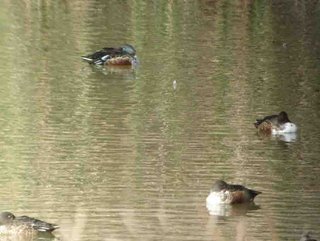
Great amount of aquatic birds, great variety of species.


Red-crested Pochard. Netta rufina and Common Coot. Fulica atra


Common Teal. Anas crecca (120 birds) and Gadwall. Anas strepera (135)


Tufted Duck. Aythya fuligula


Eurasian Wigeon. Anas penelope and Mallard. Anas platyrhynchos

Greylag Goose. Anser anser (258 birds)
Pintail. Anas acuta (17)
Northern Shoveler. Anas clypeata
Great Cormorant. Phalacrocorax carbo
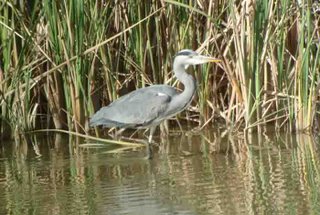
Grey Heron. Ardea cinerea


Other aquatic birds


Great Crested Grebe. Podiceps cristatus (247 birds)


Black-necked Grebe. Podiceps nigricollis

Others birds


White Stork. Ciconia ciconia


Spotless Starling. Sturnus unicolor
Common Buzzard. Buteo buteo
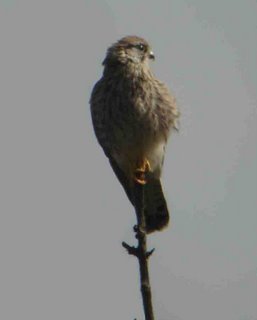
Common Kestrel. Falco tinnunculus
Yellow-legged Gull. Larus michahellis
Green Woodpecker. Picus viridis
Robin. Erithacus rubecula
Blackbird. Turdus merula
Song Thrush. Turdus philomelos
Long-tailed Tit. Aegithalos caudatus

Links recommended

Wetlands site and the Wetlands day

SEO and the Wetlands day, and the activities form 2nd to 11th february.

Monday, January 22, 2007

Winter

Mountains and rivers in winter


One of the best times of the year to observe birds in the north of Spain is the winter.
Although sometimes, bad weather and the low temperatures can be disagreeable, is without a doubt, a good moment.


Snow on the fields


The migration is without a doubt but interesting that takes place at this time, all the birds which they wintering in Africa have left, but all the birds which breeding in the north of Europe arrive in these season in great flocks.


Waders, Ducks and Gulls in the salt marsh


The best places where to see birds, are the North Coast and all the lagoons, dams, rivers... in these places arrive Divers, Auks, Waders, Gulls, Herons, Geese, and Ducks mainly.


Velvet Scoter in Santoña marshes

Inland, forests, meadow, although can seem quiet, also they maintain a good number of species those that remain the year throughout and those that arrive flocks from Thrushes, Finches, Wagtails and Pipits.
Also it is a good moment to be able to be with less habitual species, like the Wallcreeper (Tichodroma muraria) or the Lammergeier (Gypaetus barbatus), of which there are records every year.
It is necessary to be kind to great flocks, between Greylag Goose (Anser anser)
, is not always difficult to find to White-fronted Goose (Anser albifrons)
, or other species of Geese.


White-fronted Goose in a flock of Geese


Between flocks of Thrushes, the Fieldfare (Turdus pilaris) and the Redwing (Turdus iliacus) appear all winter to us.


Fieldfare in north fields of Burgos


Brambling (Fringilla montifringilla) usually is mixed in great flocks of Finches.

Also it is possible, that in these season, we find birds that usually do not appear of constant form, rare birds that many ornithologists strive in his looks for.

Friday, January 12, 2007

Great Spotted Woodpecker

Here you can see a video of a male of Great Spotted Woodpecker, looking for larvae underneath the bark of cut trunks, although the quality is not good is impressive the capacity to break the bark that have the Woodpeckers, mainly at the end of the video is possible to see the power with which it strikes, and the ability to look for the angles for strike.


This is the photo of the state in which it left the trunk.


In the north of the Iberian Peninsula it is possible to find seven species of Woodpeckers, Great Spotted and Green Woodpecker are commonest of them.

Monday, December 18, 2006

Great and Marsh Tit

I and the Bird #38

I and the Bird #38

Thursday, December 07, 2006

The first Siskins

This week the first flock of Siskins (Carduelis spinus) on the trees of river bank, eating the seeds of the alders, approximately twenty birds.

Incredible acrobats.

Monday, December 04, 2006

Again in the Reservoir


Again in reservoir of the river Ebro, a morning of good birding, with a number not a lot of species but good in speciments, mainly of the best contributed with 150 Greylag Goose (Anser anser) as always grazing in the north coast of the dam. All week I have news about the good numbers of Greylag Goose, 250, 180,…
Small flocks of other ducks, Gadwall (Anas strepera) one of the flocks of 26 birds, Common Teal (Anas crecca) this time unlike others, few units, Mallard (Anas platyrhynchos), small groups of few distributed units but in several zones.
Is strange to confirm, the Red-crested Pochard (Netta rufina) has a terrible reduction, in years ago the Red-crested Pochard was like one of most numerous in wintertime, thousands of birds, today only eight birds !!!!.

Also eight Tufted Duck (Aythya fuligula) near Reinosa.
Great Crested Grebe (Podiceps cristatus), one of the most representative birds of this dam.
Great Cormorán (Phalacrocorax carbo) two birds , and less and less, since the reiterated complaints of fishermen , at the moment is possibly regulating (to shoot) the population of birds in Cantabria and now in Burgos is studying this.
Grey Heron (Ardea cinerea), 6 birds in the zone of the observatory.
Black-headed Gull (Larus ridibundus)
Yellow-legged Gull (Larus michahellis)
Other species in the area ,
Common Woodpigeon (Columba palumbus)
Little Owl(Athene noctua)
White Wagtail (Motacilla alba)
Black Redstart (Phoenicurus ochruros)
Blackbird (Turdus merula)
Song Thrush (Turdus philomelos)
Mistle Thrush (Turdus viscivorus)
Cetti´s Warbler (Cettia cetti)
Jay (Garrulus glandarius)
Magpie (Pica pica)
Red-billed Chough (Pyrrhocorax pyrrhocorax)
Carrion Crow (Corvus corone)
Of return, in the zone of the canyons of river Ebro, a majestic Golden Eagle (Aquila chrysaetos), harassed by a pair of Peregrine Falcon (Falco peregrinus).

I and the Bird #37

I and the Bird #37

I and the Bird #36

I and the Bird #36

Monday, November 06, 2006

Marshes of Salburua

One of the cities of Spain, in which better it is lived, it is without a doubt Vitoria, and this also note in its environment.
For a long time a program has been designed to preserve, and to recover a green belt around the city, with diverse natural spaces.
One of them is the park of Salburua.


With access and parking very fast and easy, and very near of downtown, being able even to use the urban transport.
Once there, we were in an ample space of lagoons, marshes with its typical flora, and, of course, with its typical birds.
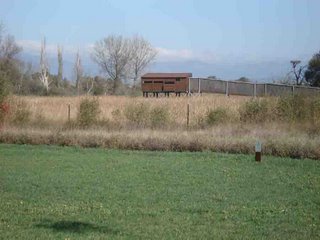
The two observatories, located and prepared very well.
A place that without a doubt there is to visit.
In only two hours, we could observe several species, including which often observing is made complicated, Water Rail (Rallus aquaticus).
The other observed species
Mallard (Anas platyrhynchos)
Northern Shoveler (Anas clypeata)
Great Cormorant (Phalacrocorax carbo)


Grey Heron (Ardea cinerea)
Common Buzzard (Buteo buteo)


Common Kestrel (Falco tinnunculus)
Moorhen(Gallinula chloropus)
Common Coot (Fulica atra)


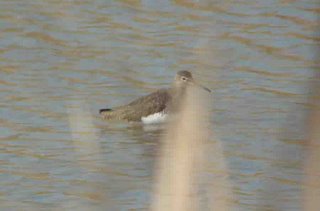
Green Sandpiper(Tringa ochropus)
Common Kingfisher (Alcedo atthis)

Wren (Troglodytes troglodytes)
Robin (Erithacus rubecula)

Cetti's Warbler(Cettia cetti)
Willow Warbler (Phylloscopus trochilus)

Great Tit (Parus major)
Magpie (Pica pica)
Carrion Crow (Corvus corone)

Friday, November 03, 2006

500 Vultures


Again, a visit to the rubbish dump of Villarcayo (Burgos) has supposed the observation of nearly 500 Griffon Vulture (Gyps fulvus), one of the concentrations greater than I have seen, practically all in flight on the place. Other observed species have been Red Kite (Milvus milvus) (35), Carrion Crow (Corvus corone) and Common Raven (Corvus corax) of which peculiarly there were very few individuals (15).


Friday, October 27, 2006

I and the Bird #35 by Dan Rhoads

I and the Bird #35

Tuesday, October 24, 2006

Report of the Yearbook- July to September 2006

You can consulted the best intersting records of the birds of Burgos, during last the three months, July, August and September.
Third report of the Yearbook of the Birds of Burgos

Remarkable records:

8 records of the Red-rumped Swallow (Hirundo daurica).
New records of the Lammergeier (Gypaetus barbatus), Osprey (Pandion haliaetus)and Black-shouldered Kite (Elanus caeruleus).
Saturday, October 21, 2006

Conferences of Steppes

These days this being celebrated in Caleruega (Ribera del Duero), province of Burgos, conferences on the steppe birds, organized by the Fundación Oxígeno.
Something very interesting, since great amount of species is disappearing the steppe zones and with them that are unique and that they are in extinction danger, one of the cases is the one of Dupont’s Lark (Chersophilus duponti) , (bird of the year by SEO) that counts in Burgos with a population very reduced and that if the destruction of steppes continues the extinction of this species will be a fact.
More information Here.

Friday, October 20, 2006

Yellow-legged Gull, Subadult

Although the weather has not been very good, we have made a new visit to the reservoir of river Ebro.
The objective, to see if there were Eurasian Spoonbill (Platalea leucorodia) or some specie of Goose in migration, we were not able to see none.
Even so from the observatory, located near of city of Reinosa, we have seen several species, some of them in numerous groups, like the dispersed groups of Sky Lark (Alauda arvensis)
, and in the river a group of 53 Black-headed Gull (Larus ridibundus)
An eight Northern Lapwing (Vanellus vanellus) resting.
Several ducks, Eurasian Wigeon (Anas penélope) , two Pintail (Anas acuta) , quite Mallard (Anas platyrhynchos), and Common Teal (Anas crecca) .
Grey Heron (Ardea cinerea) up to six specimens.
A Eurasian Sparrowhawk (Accipiter nisus) in flight by the zone.
Five juvenile of Great Cormoran (Phalacrocorax carbo) .
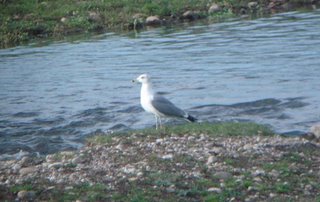
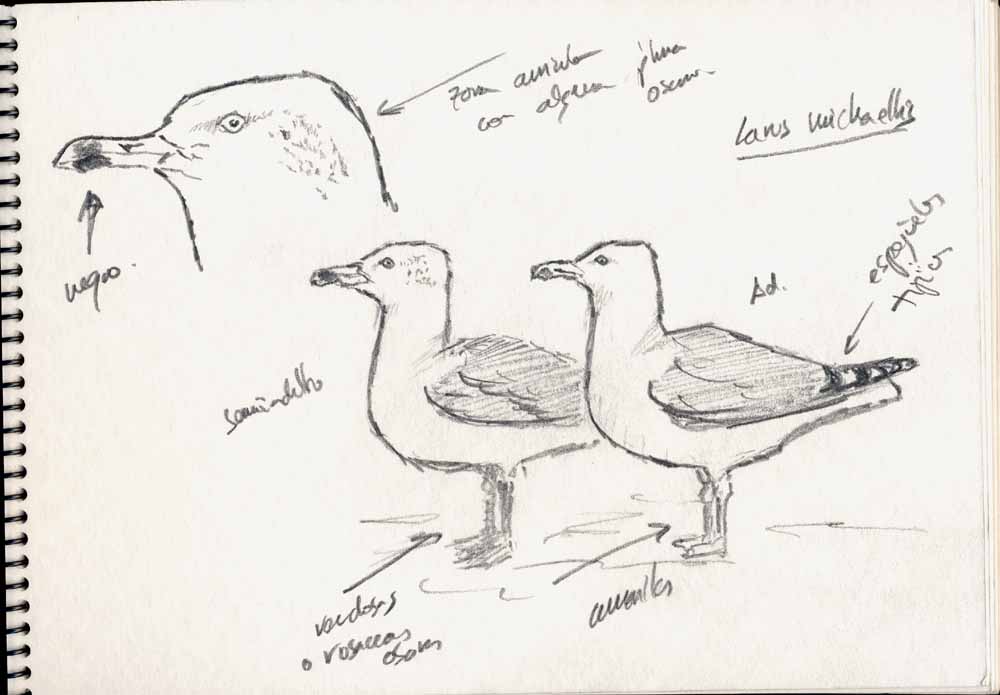
But the showy thing was the presence of Yellow-legged Gull (Larus michahellis), that although this fact is quite normal, the unusual thing was to see two birds, one of them with the own characteristics of the species and an adult, but the other with all the plumage of an adult, except very tenuous dark feathers, in the auricular zone, and the difference had in legs and bill, greenish legs, at no moment with clear tonality and the bill with a black spot a little greater than the red spot that has the adults.

After reviewing bibliography and receiver the answer of Xabi Varela , I draw a conclusion at that is a Yellow-legged Gull (Larus michahellis) of possibly was a four-winter or subadult, with the plumage already from adult but having conserved coloration from a third winter, in legs and bill.


Subadult and adult of Yellow-legged Gull (Larus michaellis)

Sunday, October 15, 2006

Ornithological Yearbook of Burgos. Volume 1


One of the most interesting projects on the birds in Burgos has been finished.
The Ornithological Yearbook of Burgos has published the Volume 1, an historical revision from the publication of the Breeding Bird Atlas of the Province of Burgos.
In this first volume, several years are included until the 2005, updating the data of the Atlas with respect to the breeding Birds.
Also one adds all the information available on the rest of species, migrate birds, wintering birds and rare birds.
With this a study of 299 species of birds is completed that of a form or another one have been detected in the province of Burgos.
Of each species his is indicated the status and the population esteem, to date of 2005, being able to compare with the reflected one in the Atlas of 1996, the most showy records and its situation comments.
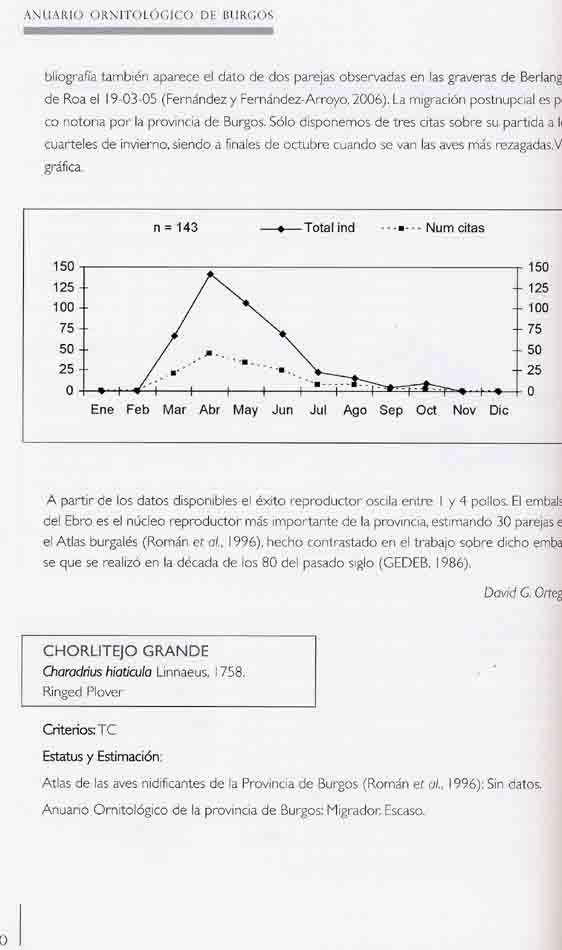
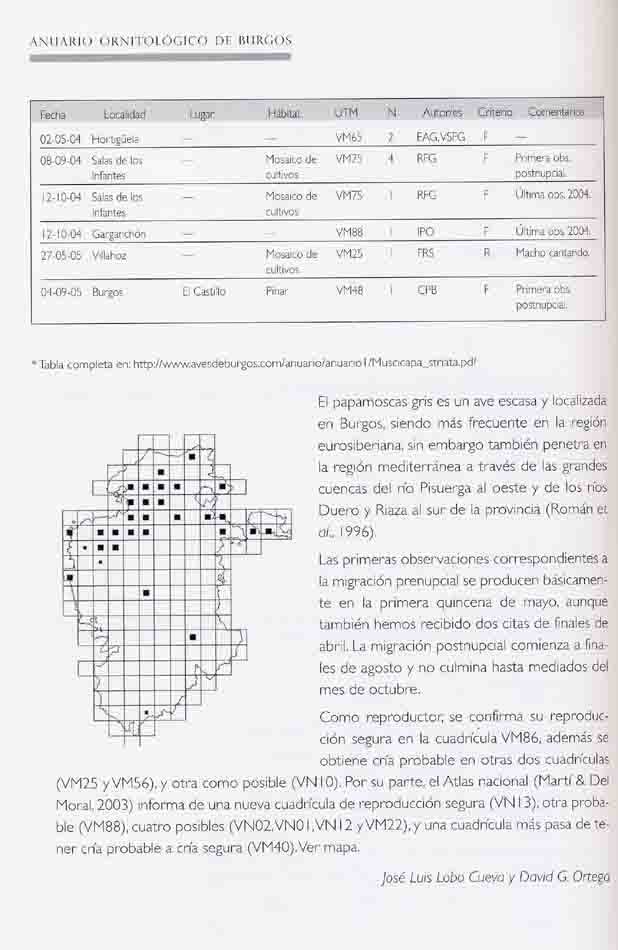
Of some species a evolution graph is contributed and others with a small map of distribution.
In the end four works are contributed about the birds in Burgos, about the Dupon´s Lark (Chersophylus duponti), White Stork (Ciconia ciconia), Black-winged Stilt (Himantopus himantopus) and Lesser Kestrel (Falco naumanni).

One of the aspects more interesting than contributes this work is that of the 53 people, between authors and collaborating, who we participated in the project of the Atlas in 1996 has gone to 163 people between coordinators and collaborating.


Graphics and Maps for some specie

All the work of the Yearbook, also this available in the Web, in :

http://www.avesdeburgos.com/anuario.htm

http://www.avesdeburgos.com/anuario/anuario1/AOBUvol1.htm

With the following mails, you can buy the book.

anuario@avesdeburgos.com

anuariodeburgos@yahoo.es

Thank you very much to the coordinators (David Gonzalez Ortega, Fernando Román Sancho, Rufino Fernández González y José Luis Lobo Cueva) by the work that, without a doubt, will benefit the birds from our province.

Saturday, October 14, 2006

I and the Bird #34 by Pam Shack

I and the Bird #34.