Sunday, June 06, 2010

Hybrid Common Redstart x Black Redstart


A spectacular bird, a hybrid of Common Redstart (Phoenicurus phoenicurus) X Black Redstart (Phoenicuros ochruros).

Discovered the last year in Dobro (More in Birds in the North of Burgos), the analysis of the photos determined the security almost that it is a hybrid of Common Redstart X Black Redstart.

The song of this bird is very similar to that of pure Common Redstart, not listening to the characteristic final note of Black Redstart, opposed to the exposed in the book Handbook of avian hybrids of the world

These two different species can nonetheless produce apparently fertile and viable hybrids.


Related articles:


British Birds:

Apparent hybrid redstarts in Finland resembling Black Redstart of eastern subspecies phoenicuroides

Journal of Avian Biology:

Hybridization between redstart Phoenicurus phoenicurus and black redstart P. ochruros, and the effect on habitat exploitation


ABSTRACT

Although redstarts Phoenicurus phoenicurus and black redstarts P. ochruros breed in different habitats they have been found to interbreed and to produce viable and fertile offspring, which backcross to the parental species. In a dual choice experiment, I investigated the preference of black redstarts and redstarts, and F1-hybrids for different habitat structures in an aviary. Black redstarts strongly preferred a perch type on which they could stand to a perch they had to cling to. Redstarts were less selective and used both perch types equally as long as food was offered between both perches on the ground. If food was given at one of the perches redstarts changed their preference depending on food location. Black redstarts, however, showed only a slight response. They always preferred the same perch type. Hybrids behaved like redstarts. They did not show a preference as long as food was placed on the ground. When food was offered at one of the perch sites they more often chose the one with food. Due to high phenotypic variability among individuals perch type preference overlapped between the three experimental groups.


Saturday, June 05, 2010

Gorges of Alto Ebro and Rudrón rivers Nature Reserve


Day of heat and good weather.Four hours of birdwatching with a total of 41 species, some of them only heard.
We crossed the valley of Zamanzas, the gorge of Tudanca and the high areas of Dobro.
First, in the Inn it went to observe the Bonelli’s Warbler, that we could throughout observe and listen to the route and in different places.
Also they accompanied all the way to us, Common Chaffinch.We contemplate to the nuptial flight of the Tree Pipit and its characteristic song.Black Kite, Short-toed Eagle and the omnipresent Griffon Vulture.
Sparrows, House Martin, Swallows and Black Redstart in Tubilleja of Ebro.
More Chaffinch, Serin and Greenfinch, in Tudanca.
We went towards the high zones through a track, Stonechat, Coots in the lagoon of Dobro, Skylarks, Whitethroat, Linnet, Common Buzzard
In the village of Dobro, Spotless starlings, House Martins and the peculiar hybrid of Common Redstart x Black Redstart.
Again in the gorges, Griffon Vulture, Egyptian Vulture, Red-billed Chough.The Bird list of the day:Black Kite
Egyptian Vulture

Griffon Vulture
Short-toed Eagle
Common Buzzard
Red-legged Partridge
Common Coot
Wood Pigeon
European Turtle Dove
Common Cuckoo
Common Swift
Wryneck
Skylark
Crag Martin
Barn Swallow
House Martin
Tree Pipit
Grey Wagtail
White Wagtail
Black Redstart
Common Stonechat

Blackbird
Mistle Thrush
Whitethroat
Blackcap
Bonelli’s Warbler
Iberian Chiffchaff
Blue Tit
Great Tit
Golden Oriole
Jay
Red-billed Chough
Jackdaw
Carrion Crow
Spotless Starling
House Sparrow
Common Chaffinch
Serin
Greenfinch
Linnet
Corn Bunting
Common Redstart X Black Redstart


Thanks to Janet and Peter for its interest in the Burgos birds

Monday, May 31, 2010

Bird News of May

The best bird records of may in Burgos province.

- Black-crowned Night Heron (Nycticorax nycticorax). Horna (C), water reservoir of river Ebro, 10-05-10 (Manuel Estébanez Ruiz). 18-05-10 Miranda de Ebro (José Eduardo Mateos). 28-05-10 Tordómar (Alfonso Rodrigo García).

- Black Stork (Ciconia nigra). 02-05-10 Ubierna (Javier Gómez Crespo). 06-05-10 Villaveta (Javier García Serna), 07-05-10 Barbadillo del Pez (Julio César Amo Fernández) 20-05-10 Mecerreyes (Santos La Roca Carazo).

- Spoonbill (Platalea leucorodia). 08-05-10 Grijalba (José María Ayuela).

- Black-winged Kite (Elanus caeruleus). 21-05-10 Humienta (Alfonso Rodrigo García).

- Grey Partridge (Perdix perdix). 02-05-10 Pico Trigaza (David González Ortega, José Pedro Portillo, Luis Miguel Ansola Aristondo, Justina Pérez Martín).

- Grey Plover (Pluvialis squatarola). 04-05-10 Villalba de Duero (Fernando Núñez).

- Red Knot (Calidris canutus). 04-05-10 Arauzo de Salce (Fernando Núñez).

- Sanderling (Calidris alba). 03-05-10 Grijalba (Justina Pérez Martín). 05-05-10 Grijalba (David González Ortega, Francisco Meléndez).

- Little Stint (Calidris minuta). 04-05-10 Arauzo de Salce (Fernando Núñez).

- Woodcock (Scolopax rusticola). 06-05-10 La Pedraja (Luis Miguel Ansola Aristondo, Mario Alonso Blanco).

- Black-tailed Godwit (Limosa limosa). 04-05-10 Arauzo de Salce (Fernando Núñez).

- Ruddy Turnstone (Arenaria interpres). 08-05-10 Grijalba (José María Ayuela).

- Little Tern (Sterna albifrons). 12-05-10 Arauzo de Salce (Fernando Núñez).

- Black Tern (Chlidonias niger). 12-05-10 Arauzo de Salce (Fernando Núñez).

- Pallid Swift (Apus pallidus). 02-05-10 Lerma (Alfonso Rodrigo García).

- European Roller (Coracias garrulus). 25-05-10 Guadilla de Villamar (Jesús González Ubierna).

- Yellow Wagtail (Motacilla flava). ssp. thunbergi and ssp. cinererocapilla Grijalba 05-05-10 (David González Ortega, Francisco Meléndez).

- Black Wheatear (Oenanthe leucura). 07-05-10 Milagros (Mario Alonso Blanco).


More in the yearbook of Burgos


Wednesday, May 26, 2010

Shorebird Mapping

Shorebird Mapping, wonderful project and a very good initiative with clear and interesting objectives:
* Monitoring the range changes of shorebird breeding populations.
* Monitoring the trends of the shorebird populations.
* Updating our knowledge on key habitat types used for each shorebird population.
* Informing decision makers about negative trends so that they make take corrective action.
* Identifying key threats and risks for different populations to support the Development of pragmatic action plans.
Although the province of Burgos is not especially interesting for the breeding Shorebirds, certainly we can contribute something on the non breeding Shorebirds mapping project.

Monday, May 24, 2010

Bird Census in VN 3040

The first days of spring,a new season of the census of breeding common birds, (European Bird Census ), in square VN3040, 45 species of birds, no new birds for this square.
Bad weather is being protagonist this spring, fall temperatures and rains, and this has noticed in the absence of birds that other years yes were present.
Common Swifts, House Martins and Swalows have not seen, only one Eurasian Crag-martin and two Alpine Swift.
Links: SACRE (Spain)
EBCC (Europe)
The list of species.
Eurasian Griffon, Common Buzzard, Common Wood-pigeon, Common Cuckoo, Alpine Swift, Common Kingfisher, Eurasian Wryneck, Eurasian Green Woodpecker, Great Spotted Woodpecker, Southern Grey Shrike, Eurasian Jay, Red-billed Chough, Carrion Crow, Blue Tit, Great Tit, Eurasian Crag-martin, Eurasian Skylark, Cetti's Warbler , Melodious Warbler, Blackcap, Bonelli's Warbler, Iberian Chiffchaff, Firecrest, Winter Wren, Wood Nuthatch, Spotless Starling, Eurasian Blackbird , Song Thrush, European Robin , Black Redstart, Whinchat, Common Stonechat, House Sparrow, Rock Sparrow, Hedge Accentor , Tree Pipit, Grey Wagtail, Chaffinch, European Serin, European Greenfinch, European Goldfinch, Eurasian Bullfinch, Eurasian Linnet, Yellowhammer, Cirl Bunting

Tuesday, May 18, 2010

The Capercaillies disappear in Asturias.

The census of the Principality disclose that in center-orients the population has decrease a 90% in ten years and they are only 3 males - the guards will carry out another count, to collate the ominous numbers and to clarify if other two Capercailles exist.
The populations of the west are possible that they are better.
The census in the west will be next year, and the experts hope that there are at least 50 males

Friday, May 14, 2010

Bad news for the Swallows

Thousand of Swallows and Martins are dying of hunger in the North of Spain by the low temperatures that have ended their food.

Barn Swallows, Common Martins, and Crag Martins are dying of hunger by thousand during these last weeks in the North of the Iberian Peninsula, because there are no insects.

More Here (spanish)

Wednesday, May 12, 2010

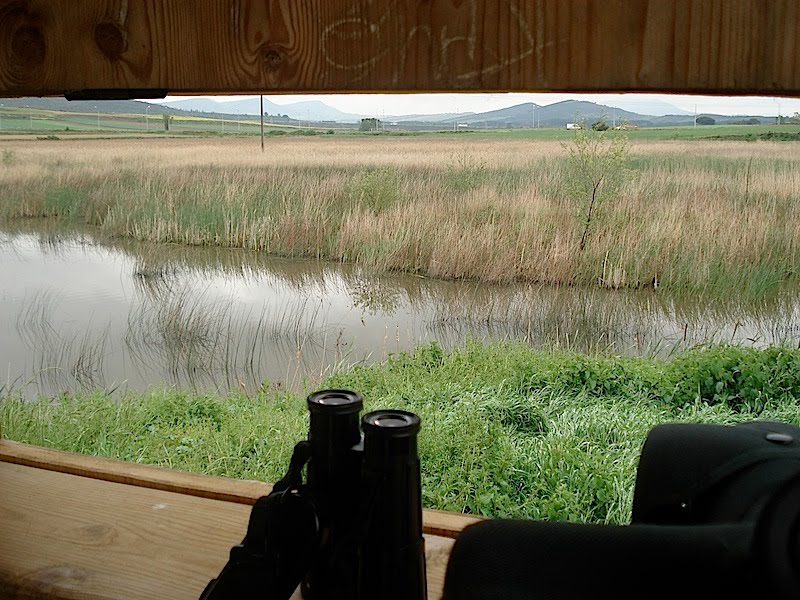
Lagoons of the Northeast of Burgos

Three lagoons in the northeast of the Burgos province, in two of them, at the moment, are carrying out works of restoration, but not thus in third.

This not always has been thus, for many years ago the intention of the nearby farmers has been to dry them.

Luckyly this was not obtained and now these two lagoons enjoy relative a good state, with water and birds.

This week, the presence of birds in migration, common flocks of Swallows and Waders.

Also birds just arrivals of Africa, Great Reed Warbler, Reed Warbler, emitting its singing incessantly.

A splendid Purple Heron camouflages among rushes.

Black Kite and Marsh Harrier, the raptors of the day.


Great Reed Warbler


Reed Warbler

Purple Heron

Barn Swallows

Crested Lark

Black Kite

List of birds of the trip by the surroundings of the lagoons:

Barn Swallow

Common Swift

Grey Heron

Purple Heron

Golden Oriole (the first of this season)

Mallard

Northern Shoveler

Green Sandpiper

Great Ringed Plover

White Stork

Corn Bunting

Crested Lark

Cetti's Warbler

Great Reed Warbler

Reed Warbler

Serin

Little Grebe

Magpie

Carrion Crow

Yellow Wagtail

Common Coot

Spotless Starling

Greenfinch

Moorhen

Blue Tit

Great Tit

Collared Dove

Pied Flycatcher

Rufous Nightingale

Melodius Warbler

Bee-eater